
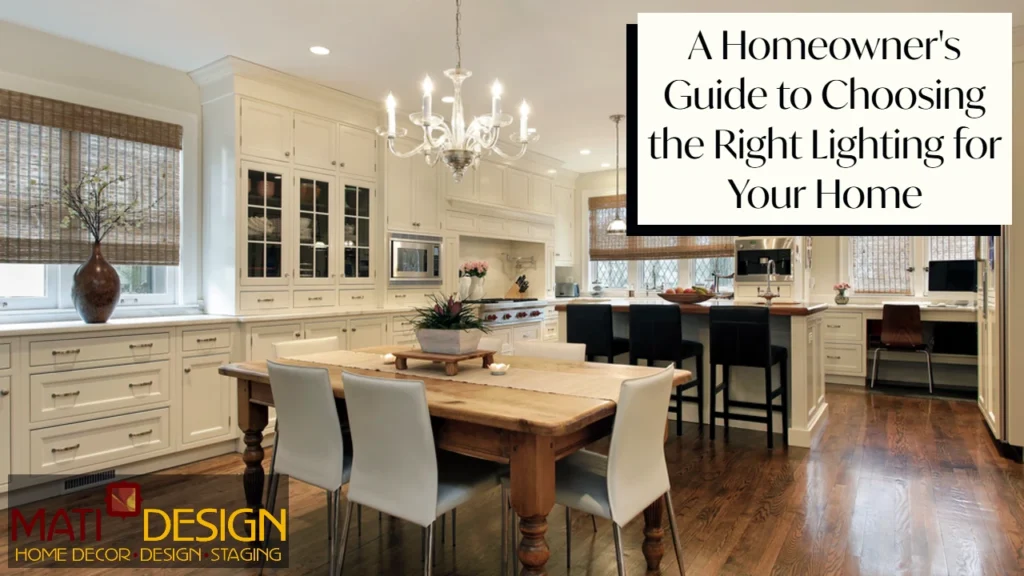
What would we do without electrical lighting?
Our homes would certainly be duller, both literally and figuratively.
We use lighting in our homes in order to properly illuminate a room while we go about our various household tasks.
But it’s also a necessity for more creative pursuits.
From painting to reading to cooking, we first need to be able to see before we can participate in these activities.
But how can you make sure that you’re using the right kind of light?
You can start by searching for tips on our home decorating and improvement blog.
And when in doubt, the experts here at Mati Design in London Ontario are always happy to advise.
Now, let’s further explore the different kinds of household lighting and how to use them.
Why Lighting Matters More Than You Think
Household lighting serves many different purposes.
Of course, there’s the functionality aspect, such as providing proper visibility as you navigate your home.
But when done right, the lighting in your home can do so much more for you.
The right kind of lighting can help determine the mood of a given room.
For instance, warm, soft lighting can help provide a welcoming atmosphere that draws people in.
The amount of light can also drastically alter the look of your room.
Whereas too much light can feel blinding, too little can leave you with the sense that a room is incomplete.
So, how do you decide which type of lighting is best for you?
The Three Types of Lighting Every Room Needs
If you haven’t put much thought into the specific types of lighting the various rooms in your home need, you’re not alone.
You might be tempted to just throw a lamp into the corners of the room and call it a day.
But if you want to go the extra mile, we’ve got you covered.
First things first: what type of light works best for each room?
In truth, most rooms require more than one type of lighting.
Let’s explore further.
Ambient Lighting
Ambient lighting works well for your general lighting needs.
As a room’s main source of light, it provides overall brightness.
It’s also the best type of light to help set the tone of the room.
For instance, a warm ambient light will make a room feel more welcoming and relaxing.
Thus, ambient lighting is most beneficial in larger rooms where you spend a significant amount of time, such as living rooms, bedrooms, and dining rooms.
Ambient lighting comes in many different forms, including:
- Ceiling lights
- Wall lights
- Floor lamps
- Windows
- Skylights
Task Lighting
As the name suggests, task lighting provides illumination for specific types of tasks, such as reading, cooking, and grooming.
It’s typically cooler and brighter than ambient light, allowing for more visibility for the task at hand.
Examples of task light include:
- Light strips under kitchen cupboards
- LED lights around a bathroom mirror
- Bedside reading lights
- Desk lights
Accent Lighting
Accent lighting helps guide your eyes towards a specific object or room feature.
It provides bright light to exhibit a focal point of the room, such as a painting or decorative item.
Accent lighting comes in different colour temperatures, depending on your needs.
A warm white accent light will provide a cozy, welcoming atmosphere whereas a cool white light will feel more focused and modern.
Sculptural lighting, which doubles as both accent lighting and a design statement, is also one of the top home renovation trends for 2026.
Examples of accent lighting include:
- Track lighting
- Wall-mounted lights
- Puck lights
How to Choose the Right Lighting for Each Room
Now that we’ve explored the different types of lighting, let’s find out which ones you’ll want to use for each room.
Living Room Lighting
Your living room is perhaps one of the most multipurpose rooms in your home.
It provides a quiet refuge that you can use for an afternoon nap or peaceful reading session.
It can also host lively events, like during family trivia night or when you’re entertaining guests.
As such, you’ll likely use various types of lighting in this room.
Ambient lighting can illuminate your entire living room for the more lively moments.
Task lighting can provide you with a strong light for reading or working.
Finally, accent lighting can help highlight your favourite piece of artwork or family photo.
If you’d like help pulling the whole room together, our interior decorating services in London, Ontario can help.
Kitchen Lighting
Unlike your living room, your kitchen isn’t much of a multipurpose room.
You might only spend time there cooking, cleaning, or eating.
All these tasks require a bright, clear atmosphere.
Therefore, it’s important to invest in a good ambient kitchen light.
You might also choose to add task lighting, such as a bright light over the stove.
If you’re planning an update, lighting is easiest to change as part of kitchen renovations in London, Ontario.
Bedroom Lighting
Your bedroom is a place of rest and relaxation, which can take many forms.
For instance, you might like to read before bed, therefore requiring some task lighting.
You also need enough light to get dressed in the morning, making ambient lighting a necessity as well.
Bathroom Lighting Ideas
Your bathroom likely already has good ambient lighting.
As a small room, it’s easier to light up all the dark corners.
But it’s also important to pay attention to the kind of light bulb you’re using in your various ambient lights.
We’ll talk more about that in the next section.
Task lighting is also a good addition to any bathroom.
For example, you might choose to add vanity lights above your bathroom mirror to help when you’re putting on makeup or brushing your teeth.
For more ideas, see our roundup of 2026 bathroom trends in London, Ontario.
 How to Choose the Right Light Bulb
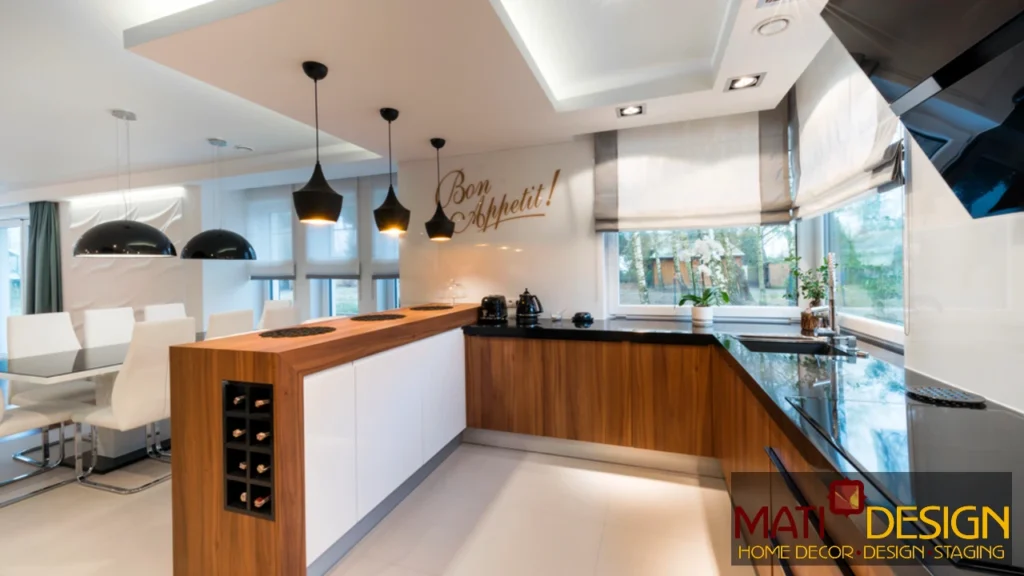 How to Choose the Right Light Bulb
Not all light bulbs work the same.
So, how do you decide which light bulbs to use?
There are a few considerations that you might make.
Colour Temperature (warm vs. cool light)
Colour temperature plays an important role in your household lighting.
It can change the way a room feels.
Light bulbs that emit a warm light operate between 2700K and 3000K.
This type of light provides a relaxing atmosphere that will help set the perfect mood in your bedroom and living room.
Conversely, lights that emit a cool light operate between 5000K and 6500K.
It’s similar to daylight and encourages alertness and focus.
Thus, these types of light bulbs work best in task-focused spaces, such as home offices or workshops.
For kitchens and bathrooms, a neutral white between 3500K and 4000K is usually the best balance, bright enough for everyday tasks without feeling harsh.
Lighting also changes how paint colours look, so test paint samples under your own bulbs. Learn more about how paint colours can affect your home.
Brightness (lumens vs. watts)
Colour temperature affects how light feels, but not how bright it is.
For that, you’ll want to look at lumens and watts.
These are both units of measurement that measure the brightness of any given light, but in slightly different ways.
Lumens measure the actual brightness of a light.
For example,
- Low light (200−300 lumens), which provides an intimate, softly lit environment
- Moderate light (400−800 lumens), which provides enough light for most general tasks
- Bright light (1000−1600 lumens), which provides strong light for high-concentration tasks, such as cooking or reading
Conversely, watts measure the amount of energy that a light uses.
For example,
- Low energy (15−25 watts), which provides enough light for an ambient light in a small space
- Moderate energy (40−60 watts), which provides enough light for soft lighting in bedrooms or living rooms
- High energy (75−100 watts), which provides enough light for bright task lighting
Keep in mind that these wattages are for traditional incandescent bulbs. LEDs use far less energy for the same brightness, so when shopping for LEDs, go by lumens instead.
Bulb Type (LED, incandescent, etc.)
Finally, you’ll want to consider the type of bulb you want to use for different lights.
The four most common types are light emitting diode (LED), compact fluorescent lights (CFL), incandescent lights, and halogen lights.
1. Light Emitting Diode (LED)
LED lights work by passing an electric current through a semiconductor.
They typically emit light in a specific direction.
They are both cost and energy efficient.
As a longer-lasting light bulb, LED lights are the perfect choice for light fixtures that are hard to reach or in rooms where you use light most often.
2. Compact Fluorescent Lights (CFL)
CFL lights have electrodes that sit at opposite ends of a gas tube.
They move energy between them in order to heat up the gases.
This creates ultraviolet light, which makes a coating inside the tube glow and give off visible light that can still feel a little harsh.
Thus, you might want to use these lights in bigger rooms or behind a light fixture that helps soften the light.
3. Incandescent Lights
Incandescent lights are the oldest type of electric light bulb.
They use electricity to heat up a metal filament.
At high temperatures, this filament appears to glow.
As you might imagine, this type of light bulb can get very warm.
However, it’s a good quality light that also looks appealing to the eye.
Thus, you might want to use it in a clear lamp in order to enjoy the view.
Keep in mind that most incandescent bulbs have been phased out in Canada, so they’re getting harder to find.
4. Halogen Lights
Halogen lights are a type of incandescent light.
Like a regular incandescent bulb, it has a metal filament, but the filament is surrounded by halogen gas, which helps it burn brighter and last longer.
It gets even hotter than a regular incandescent light, which helps it create an intense, white light.
Thus, it’s perfect for lighting up a workspace or outside on the deck or front walkway.
Common Lighting Mistakes Homeowners Make
Some of the most common lighting mistakes that homeowners make include:
- Forgetting to put lights in closets
- Being afraid to use light dimmers
- Using cold light as ambient light
- Deciding not to consult with a professional
Now that you know more about the different types of lighting, it’ll be much easier to avoid making one of these common lighting mistakes.
Good lighting matters when selling, too, which is why it’s part of our home staging services in London, Ontario.
But whenever you’re in doubt, it’s always a good idea to give us a call.
Book Your Consultation with Mati Design Today
At Mati Design, we want to make your home shine.
We provide professional painting, interior decorating, and staging services.
With our help, you can transform your house into the home of your dreams.